
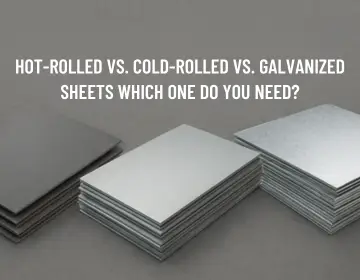
Hot-Rolled vs. Cold-Rolled vs. Galvanized Sheets: Which One Do You Need?
Steel sheets play a critical role across construction, fabrication, MEP works, industrial manufacturing, and oil & gas operations. But choosing the right type — Hot-Rolled (HR), Cold-Rolled (CR), or Galvanized (GI) — can significantly affect cost, performance, durability, and structural reliability.
For procurement teams, engineers, and project managers in the UAE, the choice isn’t just technical — it impacts logistics, project timelines, and compliance with regional specifications. This guide breaks down everything you need to know to make a confident, informed decision.
Technical Overview: HR vs. CR vs. GI Steel Sheets
What Are Hot-Rolled Sheets?
Hot-rolled steel sheets are produced by rolling steel at temperatures above 900°C.
This high-temperature process results in:
- A scaly, rough surface
- Slight dimensional variations
- Superior malleability for bending, welding, and fabrication
Key Technical Characteristics:
- Tolerance: Less precise than cold-rolled
- Strength: Good for structural applications
- Finish: Matte, scaled surface
- Availability: Widely stocked in GCC
What Are Cold-Rolled Sheets?
Cold-rolled sheets are made by processing hot-rolled coils further at room temperature through precision rollers.
This results in:
- Tight dimensional accuracy
- Smoother, polished surface
- Higher strength (due to strain hardening)
Key Technical Characteristics:
- Tolerance: Very precise
- Strength: Higher than HR sheets
- Finish: Smooth, bright, premium
- Applications: Appliances, automotive, precision fabrication
What Are Galvanized Sheets?
Galvanized steel sheets (GI) are hot-dip zinc-coated to protect the surface against rust and corrosion.
Key Technical Characteristics:
- Corrosion Protection: Excellent (zinc barrier + sacrificial action)
- Finish: Shiny, spangled or non-spangled
- Durability: High for outdoor / marine environments
- Lifespan: Long due to zinc coating
Comparative Summary: Which Sheet Suits Your Requirement?
| Property | Hot-Rolled (HR) | Cold-Rolled (CR) | Galvanized (GI) |
|---|---|---|---|
| Surface Finish | Rough | Smooth | Smooth, coated |
| Dimensional Accuracy | Medium | High | High |
| Corrosion Resistance | Low | Low | Very High |
| Strength | Good | Higher | Moderate–High |
| Cost | Lowest | Medium–High | Higher |
| Best For | Structural & heavy fabrication | Precision fabrication & aesthetics | Outdoor, marine, HVAC, MEP, oil & gas |
Industry Applications
Applications of Hot-Rolled Sheets
Ideal for structural and heavy-duty tasks such as:
- Construction & building frames
- Storage tanks
- Industrial fabrication
- Base plates, gussets, brackets
- Oil & gas structural supports
- Machinery components
HR sheets are preferred where strength matters more than appearance.
Applications of Cold-Rolled Sheets
Best suited for precision manufacturing and applications requiring tight tolerances:
- Automotive body panels
- Electrical cabinets
- Furniture and shelving
- HVAC equipment
- Home appliances
- High-precision fabrication workshops
CR sheets are ideal where finish quality and accuracy are essential.
Applications of Galvanized Sheets
Popular in environments exposed to humidity, chemicals, and harsh weather:
- HVAC ducting
- Cable trays and electrical enclosures
- Roofing and cladding
- MEP installations
- Outdoor signage
- Oil & gas field fabrications
- Water heaters, tanks, and pipelines
- Solar panel mounting structures
GI sheets provide excellent long-term protection against corrosion — a critical benefit in GCC climates.
Procurement Insights: Selecting the Right Steel Sheet
1. Prioritize Application and Environment
- For structural frames → HR
- For precision fabrication → CR
- For corrosion-prone environments → GI
- For MEP ducting → GI preferred
- For oil & gas → GI or specially-coated steel
2. Consider Finishing & Aesthetic Requirements
If surface finish is important (e.g., exposed panels), CR or GI sheets deliver better results.
3. Evaluate Strength & Tolerance Needs
Cold-rolled sheets offer the highest dimensional precision.
Hot-rolled sheets are best for heavy-duty strength without cost inflation.
4. Understand Local Standards & Compliance
In the UAE, projects often follow:
- ASTM
- BS EN
- JIS
- ISO material specifications
Always request:
- Mill Test Certificates (MTCs / MTRs)
- Coating weight (for GI sheets)
- Grade confirmation (e.g., SS400, SPCC, DX51D)
5. Optimize Procurement Logistics
Noble FZE recommends:
- Combining mixed steel orders (HR + GI + pipes + fittings)
- Bulk procurement to reduce freight cost
- Confirming coil vs. sheet availability (stock varies by market cycle)
- Using suppliers with strong warehousing and UAE logistics
Advantages of Each Steel Sheet Type
Advantages of Hot-Rolled Sheets
- Most economical steel sheet option
- Excellent for welding and fabrication
- Good strength for heavy applications
- Easy to form during manufacturing
Advantages of Cold-Rolled Sheets
- Superior surface finish
- High dimensional precision
- Stronger due to work hardening
- Ideal for premium-grade industrial products
Advantages of Galvanized Sheets
- Premium corrosion resistance
- Long lifespan in humid/marine climates
- Low maintenance requirements
- Suitable for HVAC, MEP, and construction
- Economical compared to stainless steel
UAE Market Insights
The UAE steel market continues to grow driven by:
- Mega infrastructure projects
- Residential and commercial expansions
- Oil & gas facilities
- Manufacturing and industrial development
- Rising demand for HVAC and MEP materials
What this means for procurement teams:
- GI sheets remain in high demand due to climate conditions
- CR sheets see consistent use in manufacturing and fabrication sectors
- HR sheets account for a large portion of structural steel demand
UAE buyers typically prefer suppliers who offer multi-category procurement — reducing vendor management complexity.
This is where Noble FZE stands out.
Why Choose Noble FZE as Your Steel Sheet Supplier?
Noble FZE is a UAE-based industrial materials trading company with global sourcing capabilities across steel products, industrial hardware, valves, pipes, fittings, MEP materials, construction supplies, and oil & gas equipment.
What Sets Noble FZE Apart
- Reliable Global Sourcing: Partnerships with trusted mills and manufacturers
- Wide Steel Inventory: HR sheets, CR sheets, GI sheets, coils, pipes, beams, channels, plates
- Full MEP & Industrial Range: HVAC materials, valves, fittings, flanges, hardware, & fasteners
- Quality Assurance: Mill Test Certificates, compliance with international standards
- Efficient Logistics: Fast delivery across the UAE & GCC
- Integrated Procurement: Consolidate multiple categories under one supplier
For industrial contractors, construction firms, oil & gas companies, and MEP contractors, Noble FZE provides end-to-end procurement reliability.
FAQs
Q1: Which steel sheet is best for outdoor applications?
Ans: Galvanized sheets (GI) due to their zinc coating that protects against corrosion.
Q2: Are cold-rolled sheets stronger than hot-rolled sheets?
Ans: Yes. Cold-rolling increases hardness and tensile strength through strain hardening.
Q3: When should I choose hot-rolled sheets?
Ans: When the application requires structural strength and aesthetics are not critical — such as frames, supports, and heavy fabrication.
Q4: Are galvanized sheets suitable for oil & gas sites?
Ans: Yes — especially for cable trays, ducting, enclosures, and non-immersed components.
Q5: Can Noble FZE supply both sheets and fittings together?
Ans: Absolutely. Noble FZE specializes in bundled procurement, including pipes, fittings, valves, hardware, and MEP materials.
Conclusion
Choosing the right steel sheet — Hot-Rolled, Cold-Rolled, or Galvanized — depends on your project’s technical, environmental, and economic requirements.
Hot-Rolled for structural strength and heavy fabrication
Cold-Rolled for precision and superior finish
Galvanized for corrosion resistance and outdoor durability
In the UAE’s demanding environment, selecting the correct steel sheet is crucial for long-term performance and cost efficiency.
Noble FZE ensures you receive the right material with consistent quality, reliable delivery, and expert procurement support across steel products, industrial hardware, MEP supplies, construction materials, and oil & gas equipment.