
Rebar vs. Wire Rod: How to Select the Right Steel for Your Project
Choosing between rebar (reinforcing bar) and wire rod is a common decision for engineers, procurement teams, and construction contractors. The right choice affects structural performance, fabrication efficiency, cost, and supply-chain logistics. This article explains the technical differences, industry applications, procurement insights, advantages of each material, and what the UAE market looks like — plus why Noble FZE is a partner of choice for projects across construction, MEP, oil & gas, and industrial sectors.
What are Rebar and Wire Rod? Technical Definitions & Standards
What is Rebar?
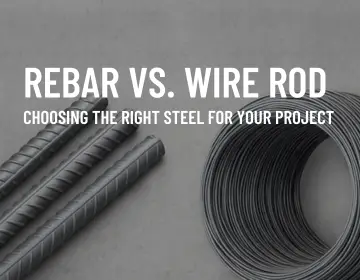
Rebar (reinforcing bar) is a ribbed or textured steel bar manufactured primarily for reinforcing concrete. Typical diameters range from about 6 mm up to 40 mm and above; common standards include BS 4449, ASTM A615 and regional equivalents that specify grade, yield strength, ductility and weldability. Rebar’s ribs improve bond with concrete and ensure predictable structural performance under tension and shear loads.
What is Wire Rod?
Wire rod is a hot-rolled coiled product with smaller diameters (commonly 5–20 mm depending on the producer/region) and is often supplied in coils rather than straight bars. Wire rod is a primary feedstock for wire drawing, nails, mesh, fasteners and for some reinforcement applications (e.g., brick reinforcement, welded wire mesh, bent/formed elements). Its production parameters and chemical composition are tailored for downstream forming and drawing operations.
Key Technical Differences (At a Glance)
Form & Delivery: Rebar typically supplied straight (or in cut-to-length) with ribs; wire rod is coiled and smooth.
Diameter & Strength: Rebar sizes and grades are standardized for structural design; wire rod diameters are smaller and intended for forming or drawing.
Bonding to Concrete: Rebar’s deformations (ribs) give superior bond for reinforced concrete; wire rod requires mesh or concrete cover strategies.
Flexibility & Fabrication: Wire rod is more flexible and suited to cold forming, welding and making fasteners; rebar is stiffer and used as primary reinforcement.
Industry Applications: Where Each Material Excels
Rebar — Best For:
Structural reinforced concrete (foundations, columns, beams, slabs, bridges, tunnels).
Projects requiring certified yield strength and ductility (high-rise buildings, infrastructure).
Wire Rod — Best For:
Producing wire, nails, screws, mesh, prestressing wires, and drawn wire products.
Secondary reinforcement: welded wire mesh, brick reinforcement, ties, stirrups and formwork fixings.
Procurement Insights: How to Specify & Buy
Specify by application, not name. Use functional requirements (yield strength, ductility, coating, grade) when placing orders. If you need primary reinforcement for structural concrete, specify rebar to a recognized standard (e.g., BS/ASTM); for mesh or wire products, specify the wire rod composition and coil size.
Check certifications & mill test reports (MTRs). Ask suppliers for MTRs and third-party test certificates that show chemical composition, tensile/yield results and compliance with regional standards.
Consider form and logistics. Coiled wire rod reduces transport space but may increase on-site handling for straightening; rebar arrives in straight lengths or pre-cut rebar cages for faster installation.
Coatings and corrosion protection. For coastal or oil & gas sites in the UAE, request epoxy-coated or stainless alternatives where corrosion resistance is critical.
Lead times and market volatility. Steel prices and availability can shift with global scrap and production cycles — plan orders and build supplier redundancy. Recent UAE market reports show strong infrastructure demand and growth in rebar consumption; working with trading partners who maintain regional stocks shortens lead time and risk.
Advantages: Rebar vs. Wire Rod
Rebar Advantages
Engineered for structural reinforcement with proven performance metrics (yield, ductility).
Better bond with concrete due to ribs; widely referenced in structural codes.
Wire Rod Advantages
Versatile feedstock for fast-moving fabrication lines (wire drawing, nails, mesh).
Typically lower unit cost for secondary reinforcement and downstream manufacturing.
UAE Market Relevance & Considerations
The UAE remains a high-growth market for construction steel because of ongoing infrastructure, industrial and oil & gas investment. Market reports indicate continued expansion in rebar demand driven by public infrastructure and real estate projects; procurement teams must balance price sensitivity with compliance to international standards and corrosion protection for marine/coastal projects. Working with suppliers who have regional stock and logistics capabilities reduces project risk.
Why Choose Noble FZE
Noble FZE is a Dubai-based international trading company with established supply lines across the UAE, India, China and East Africa. We deliver tailored steel solutions across Noble’s product categories — industrial hardware, valves, pipes & fittings, steel products, MEP materials, construction supplies, and oil & gas equipment — making us uniquely positioned to support integrated procurement needs for complex projects. Noble FZE offers:
Verified product quality & MTRs from global mills.
Cross-category sourcing: combine rebar or wire rod purchases with related MEP items, valves, or fittings to simplify logistics and vendor management.
Regional stock and logistics: faster shipment, customs handling and project-stage delivery across the UAE and GCC.
Technical support: specification advice to align material grade, coating and form to your application — from high-rise reinforcement to oil & gas fabrication.
FAQs
Q1: Can wire rod be used instead of rebar in reinforced concrete?
A1: For primary structural reinforcement, no — you should use ribbed rebar that meets relevant standards. Wire rod can be used for secondary reinforcement (mesh, ties) or where design allows coil-based reinforcement, but verify design code compliance. Concrete Centre
Q2: Which is cheaper — rebar or wire rod?
A2: Unit-for-unit, wire rod is often less expensive for small-diameter products and fabrication feedstock. Rebar is priced differently because of its grades, deformations and certification requirements.
Q3: What standards should I ask for in the UAE?
A3: Commonly accepted standards include BS 4449 for rebar and corresponding ASTM or ISO equivalents. Always request MTRs showing compliance to the specified standard.
Q4: How does corrosion resistance compare?
A4: Both products can be supplied with corrosion-mitigating treatments (galvanizing, epoxy coating, stainless grades). Coastal or oil & gas environments usually require enhanced protection.
Q5: How do lead times compare?
A5: Lead times depend on mill stock and regional inventory. Rebar is frequently stocked by mills and distributors in long lengths; wire rod is lighter and often available in coils — partner choice matters for reliable delivery.
Conclusion
Selecting rebar vs. wire rod is not a one-size-fits-all decision — it depends on structural requirements, fabrication needs, cost, coatings, and local market availability. For primary structural reinforcement in buildings and infrastructure, ribbed rebar that conforms to recognized standards is typically the correct choice. For fabrication, mesh and fasteners, wire rod is the efficient feedstock. In the UAE’s expanding market, combining technical specification discipline with a supplier that provides inventory, certifications and cross-category product capability reduces project risk and cost.
Partner with Noble FZE to gain access to certified steel products, regional logistics, and procurement solutions across industrial hardware, valves, pipes & fittings, steel products, MEP materials, construction supplies and oil & gas equipment. Contact Noble FZE to discuss project specifications, request MTRs, or arrange a tailored supply plan.